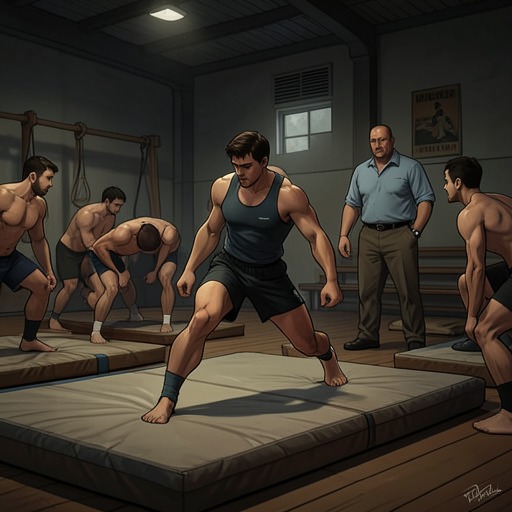
Steering wrestling team
The World According to GarpThe Steering wrestling team gives T. S. Garp a demanding daily purpose after his return to coaching, and briefly turns his energy into measurable success: a 9–2 season, a second-place New England tournament trophy, and an individual champion. Its wrestling room, however, becomes the scene of Garp’s assassination, binding the team’s close-knit routine to the novel’s sudden violence. In later years the team’s glory fades, but Dean Bodger continues to support it, dying in the stands while urging a struggling heavyweight onward.
Coaching and a Winning Season
When Garp is estimating the team’s prospects against Bath, its record stands at 8–2. The strong foundation has been laid by Ernie Holm, who has coached several wrestlers for the previous two or three years; Garp, in turn, has kept the team sharp. The final dual meet against the school’s arch rival is still ahead, and Garp’s attention is fixed on how the individual weight classes might fare.
The team beats Bath in that final meet and finishes the season 9–2. It also places second in the New England tournament and produces one individual champion: a 167-pound wrestler with whom Garp has personally done the most work. The results mark the payoff of a season in which inherited coaching and Garp’s close involvement combine. Yet the season’s end leaves Garp, a retired writer, with too much time on his hands, showing how coaching has become not simply an achievement but a structure for his days.
Garp’s Daily Work in the Wrestling Room
In a later season, Garp’s commitment is visible in a sequence of precise routines. On a snowy day he runs from Buster’s Snack and Grill to the Seabrook Gymnasium and Field House in less than three minutes, arriving cold before warming his feet in the trainer’s room and putting on his wrestling shoes. He checks on a 145-pound wrestler whose taped finger is only sprained, asks about the X ray, and questions the boy’s weight before going to change.
Garp also stops to put Vaseline on an ear showing the effects of wrestling. He dislikes headgear, which was not required in his own wrestling days, and thinks the slick coating will protect the ear. Before opening the wrestling room, he runs a mile with a 152-pounder, challenges him to a final-lap sprint, and loses by six feet. He then works with the boy on the mat, taking him down, riding him, and letting him attempt a reversal and pin. When a tight back muscle limits him, Garp sends the boy to work with someone else and sits against the padded wall, watching his team fill the room.
Garp dislikes organized calisthenics, so he lets the wrestlers warm up independently before demonstrating drills. He insists that Eric, his 133-pounder, find a harder partner rather than coast through practice with his roommate and best friend, a second-string 115-pounder. The team’s discipline is built through these small corrections as much as through formal instruction: Garp watches closely, identifies where a wrestler is taking it easy, and makes the work harder.
The Team as a Center of Family Life
The wrestling season changes the household’s emotional rhythm. As it begins again, Garp becomes focused and relentless, resembling the determined young man who first drew Helen to him. Helen feels pulled toward him, though she finds herself alone and crying without knowing why; she recognizes that she has remained inactive too long and agrees to teach at Steering School, where she can use her mind and develop her own ideas. With work of her own, she becomes less anxious.
Helen also teaches Ellen James to drive. Ellen makes the twice-weekly trip to the state university for a creative-writing course, prompting Garp to tease her that the family is not large enough for two writers. The renewed work of both women accompanies Garp’s good mood and the team’s return to his attention. At the same time, his coaching can occupy him so completely that ordinary gestures between husband and wife are displaced by practice: when Helen enters the hot wrestling room, Garp has a whistle in his mouth and does not kiss her as she passes. The remembered moment acquires lasting significance because it is their final missed opportunity before his death.
The Wrestling Room and Garp’s Assassination
On the day Garp is killed, the team is practicing in the Seabrook Gymnasium and Field House. Garp runs to the gym without his hat, checks on the wrestlers, completes his familiar warm-up with the 152-pounder, and watches the practice clock. The room is crowded with working pairs, and the temperature has risen to about 85 degrees. Helen sits in her usual corner with a book, her glasses fogging as she reads; the activity around her is familiar enough that she looks up only at a particularly loud impact or cry.
A nurse enters and moves through the room toward Garp. When he sees the gun, he recognizes that the uniform is not an ordinary nurse’s uniform but a Jenny Fields Original. He identifies the attacker as Bainbridge Percy, known as Pooh, through the family resemblance. The moment turns the team’s ordinary practice into a scene of public catastrophe: Garp is shot twice, while the wrestlers, still boys, are initially stunned and unable to move.
Helen tackles Pooh Percy before she can fire again. Her cries bring the wrestlers into action: a second-string heavyweight restrains the attacker, and the starting 145-pounder takes the gun from her. The team members’ roles in the incident are direct and immediate, not those of spectators alone. The practice room that had been organized around timed rounds and partner drills becomes the space where Helen and the wrestlers try to stop the attack.
Decline and Dean Bodger’s Loyalty
The team’s success does not last. In the years that follow, its glory days recede from most people’s memories, and it becomes a losing team. Its wrestlers never again have a coach equal to Ernie Holm or Garp. Dean Bodger nevertheless remains loyal, continuing to attend meets and call encouragement to a Steering wrestler who is close to being pinned.
Bodger dies at one such match, during an unusually close bout in the unlimited class. The Steering heavyweight and an exhausted, out-of-shape opponent struggle for position as the clock runs down. Bodger stands and urges the wrestlers on, his German emerging in his final shout. When the match ends and the spectators leave, he is found dead in his seat. His death completes the team’s long association with him: even after its competitive standing has collapsed, he remains present, encouraging its wrestlers until the end.